Search Reputation
Content Removal vs Search Suppression: What's the Difference?
Milan Eedel Bloedt
Founder, Info Remover
Milan Eedel Bloedt has worked in search for over seven years, including in the iGaming sector where aggressive SEO tactics, fraudulent DMCA complaints and coordinated negative content are common. He founded Info Remover to handle content removal, de-indexing and search suppression cases with fixed scope and realistic expectations.
LinkedIn profile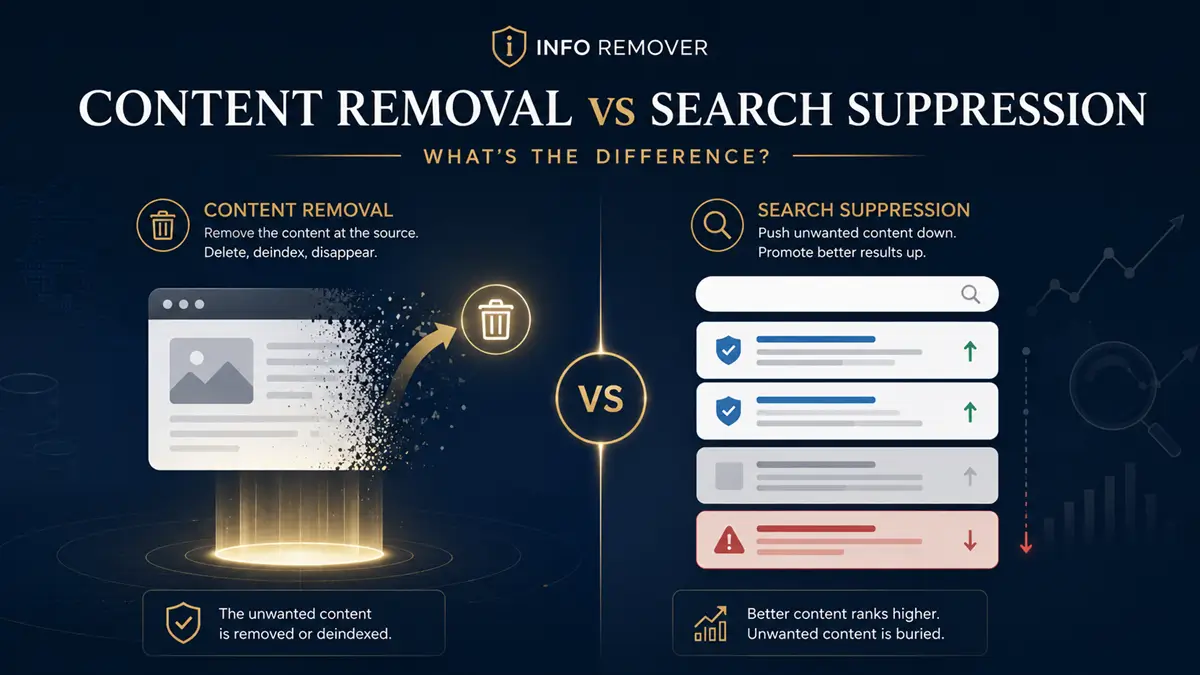
People often use the words removal and suppression as if they mean the same thing. They do not. They describe two different strategies for dealing with unwanted search results, and choosing the wrong one can waste months of work, set unrealistic expectations, or delay the action that would actually help.
This guide explains what content removal and search suppression are, when each one fits, what they cannot do, and how they sometimes work together. It is written for individuals, professionals, executives, founders, creators and businesses dealing with content that is unwanted, outdated, harmful or reputation-sensitive.
Why the difference matters
Most people who reach out about an unwanted Google result start with the same sentence: "I want this removed." That is a fair instinct. In practice, only a portion of unwanted search results can actually be removed. The rest have to be managed differently.
Content removal tries to remove, update or deindex a specific URL. It is a targeted action against a single page, image, profile or listing. The goal is for the content to no longer exist in the place it currently appears, or to no longer appear in search.
Search suppression takes a different route. It does not delete anything. Instead, it works to reduce the visibility of the unwanted result by building or strengthening other results that can rank above it. The unwanted page may still exist, but a person searching for your name or brand sees it less easily.
Sometimes both are used together. A case may begin as a removal effort and shift into suppression when removal is rejected, partial, or impossible. The two strategies are not in competition. They solve different problems.
Choosing the wrong one early on is one of the most common reasons people feel stuck with an unwanted result. Filing removal requests against an accurate news article rarely succeeds. Trying to suppress an outdated personal listing that a publisher would simply update on request is a slow, expensive way to solve a problem that had a faster answer.
What is content removal?
Content removal focuses on a specific piece of content. That can be a webpage, an image, a forum post, a directory listing, an old article, a profile on a third-party platform, or a single search result. The work is targeted, evidence-driven and bounded by the URL or URLs involved.
A content removal project may involve any combination of the following: contacting a website owner or publisher and requesting an update or deletion; asking a platform to review a policy violation; submitting Google or Bing deindexing requests where the content qualifies; clearing outdated cached search results after the source page has changed; reporting fake profiles or impersonation; and requesting removal of personal information from people-search sites and data brokers.
One important nuance: removal from a search engine is not the same as removal from the source website. Google or Bing may deindex a URL so it no longer appears in search, while the page itself still lives on the publisher's site. The reverse is also possible. A publisher may delete a page while Google continues to show the cached version for a while. A thorough removal effort works both sides of that gap.
For more on what this looks like in practice, see content removal.
When content removal makes sense
Content removal is usually the right first option when the situation has clear, narrow boundaries. The cases that respond best to removal tend to share a few features.
The content is clearly outdated and the underlying facts have changed. The source page was already removed but Google still shows it. The result contains personal information that should not be public. The page breaks a clear platform or publisher policy. The content is copied, fake or impersonates someone. The publisher is the kind of organization that responds to reasonable requests. The issue involves one URL or a small handful, rather than a sprawling footprint.
Content removal may be the right fit if you know the exact URL, the issue is limited in scope, there is a clear reason for removal or update, the source website or platform can be contacted, the content may qualify for search engine removal, and you want a process with a defined start and end.
When all of those line up, removal is usually faster and more durable than suppression. The unwanted result is gone, not buried.
What content removal cannot guarantee
This is the part that gets understated in a lot of marketing copy, so it is worth saying plainly. Info Remover cannot guarantee that Google, Bing, publishers, platforms or website owners will remove content. They each make their own decisions, on their own timelines, under their own policies.
Some content is accurate, newsworthy, part of the public record, legally protected or simply not eligible under search engine and platform policies. A request can be approved, rejected, ignored or accepted only in part. A page that gets deindexed once can come back. A platform that removes a profile today may allow a near-identical one tomorrow.
Good removal work is honest about that. It picks the cases where removal is realistic, presents the evidence cleanly, and tracks the outcome. It does not promise results that depend on other people's decisions.
What is search suppression?
Search suppression is a different strategy with a different goal. It does not try to delete the unwanted content. It tries to reduce how often people see it.
In practice, suppression means strengthening and building search results that can rank above the unwanted one. When stronger positive or neutral assets sit at the top of the page, the unwanted result moves down. For most people, the first page of Google is the only page that matters, so moving a result from position three to position twelve has the same practical effect as removing it, even though the source page still exists.
A suppression program may include a search result audit; keyword and reputation risk mapping for the names, brands and terms that matter; optimizing existing profiles you already control; publishing positive or neutral content on credible platforms; strengthening personal or company profiles with consistent, accurate information; creating and maintaining controlled assets such as personal sites, professional pages and verified profiles; improving branded search presence with structured, accurate information; and monitoring ranking movement over time so progress is measurable rather than assumed.
For more on how this works, see search suppression.
When search suppression makes sense
Suppression tends to be the right choice when removal is unlikely, when the footprint is too large to address one URL at a time, or when the goal is broader than a single page.
It often becomes the better option when the unwanted content cannot be removed; Google has rejected removal requests; the publisher will not respond or refuses; the content is a news article, public record or otherwise legally protected; multiple search results are involved; the issue affects the first page of Google for a name or brand; the goal is to improve overall search presence rather than fight one URL; or the reputation issue calls for a longer-term visibility strategy rather than a single takedown.
Search suppression may be the right fit if the content is unlikely to be removed, the issue is ranking visibly for your name or brand, you need stronger positive or neutral assets, you want to reduce visibility rather than delete the source, you are preparing for hiring, fundraising, media attention or due diligence, and you can commit to a process that plays out over months rather than weeks.
Suppression is slower than removal when removal works. It is more reliable than removal when removal does not.
Content removal vs search suppression: side-by-side
A short comparison may help anchor the difference.
On main goal, content removal aims to remove, update or deindex a specific piece of content; search suppression aims to reduce the visibility of unwanted results.
On typical target, content removal acts on exact URLs, images, profiles or listings; search suppression acts on the search result pages for names, brands or keywords.
On best fit, content removal suits outdated content, personal information, policy violations, fake profiles and small URL counts; search suppression suits hard-to-remove articles, public records, negative news and stubborn page-one results.
On timeframe, content removal can resolve in days or weeks when the case is eligible; search suppression usually plays out over several months.
On control level, content removal depends heavily on search engines, platforms and publishers; search suppression depends on the strength and consistency of the assets you can build and maintain.
On outcome, content removal may end with the content removed, updated, deindexed or refreshed; search suppression may end with unwanted results moving lower in search over time.
On guarantees, neither approach can be guaranteed. Search engines, platforms, publishers and ranking algorithms make their own decisions.
On common limitations, content removal is limited by eligibility and the willingness of third parties to act; search suppression is limited by time, content quality and the competitive search environment.
On example use case, content removal fits an outdated article a publisher is willing to update; search suppression fits a years-old news story that still ranks for an executive's name.
Example 1: an outdated page still appears in Google
A profile lists an old job title, an old company or out-of-date personal details. The publisher is reachable. In this case, content removal or an update request is usually the first route. If the source page is updated or removed, Google will eventually refresh the result. Suppression may not be needed at all if the search engine reflects the change.
Example 2: a negative article cannot be removed
A mainstream news article covers a real event. The reporting is accurate, the publisher stands behind it, and there is no clear policy violation. Removal is unlikely. Suppression is the more realistic strategy. The work shifts to building stronger results that can rank above it over time.
Example 3: a fake profile appears in search results
A profile impersonates someone on a social platform or a directory site. The first step is usually content removal or platform reporting under impersonation rules. If the profile is removed but copies reappear, ongoing monitoring and additional removals may be needed. Suppression can support the effort by ensuring the real, verified profiles rank above any future fakes.
Example 4: personal information appears on multiple sites
Home address, phone number or other personal details are listed across several people-search sites and data brokers. The first move is usually data broker removal and, where relevant, doxxing removal and broader content removal. Because data broker sites often refresh from other databases, monitoring and periodic cleanup matter as much as the initial removal work.
Can removal and suppression be used together?
Yes, and in practice they often are. A reputation case rarely fits neatly into one bucket. A typical combined approach looks like this.
First, identify the unwanted URLs and group them by type: removable, possibly removable and unlikely to be removed. Second, submit removal or deindexing requests where appropriate, and contact publishers or platforms where that is included. Third, track responses and document outcomes so the case has a clear record. Fourth, in parallel or once removal options are exhausted, begin building and strengthening positive search assets to suppress the results that remain. Finally, monitor ranking changes over time and adjust the strategy based on what actually moves.
This sequencing matters. Trying to suppress a result that a publisher would have updated on request wastes effort. Trying to remove a result that no one will take down delays the work that would have actually helped.
Which option should you choose first?
A short rule of thumb.
Choose content removal first if you have a specific URL, the content looks removable on its merits, the issue is outdated, personal, fake or policy-sensitive, and you want a fixed-scope review with a clear yes or no.
Choose search suppression first if the content is unlikely to be removed, the result is a news article, public record or stubborn page-one entry, you need broader search improvement across multiple terms, or you are dealing with several unwanted results at once.
When in doubt, an honest audit answers the question faster than guessing. The right strategy depends on the content, the source, the visibility, the urgency and what is realistically available.
What Info Remover can help with
Info Remover takes a fixed-scope approach. Each engagement starts with a clear scope, a defined price and a documented process. The goal is to help clients pick the most realistic route based on the content type, source website, search visibility and available evidence, rather than promising outcomes that depend on third parties.
Info Remover can help with content removal request management; Google and Bing deindexing submissions where the content qualifies; outdated content cleanup; publisher or webmaster outreach where included in the scope; search suppression strategy; Google Images cleanup; fake profile and impersonation reporting; data broker removal; doxxing exposure review; right to be forgotten requests under EU and UK law; and ongoing executive monitoring with outcome reports.
A practical note on expectations. Removal, deindexing and ranking changes are not guaranteed. Search engines, publishers, platforms and website owners make their own decisions, and rankings depend on factors outside any single provider's control. What Info Remover manages is the process: the analysis, documentation, submissions, outreach where included and the monitoring that follows.
If you would like to see the services directly, view content removal or search suppression for the full scope and pricing of each.
Final thoughts
Content removal is the right strategy when a specific URL, image, profile or page may be removed, updated or deindexed. Search suppression is the right strategy when the content is unlikely to disappear and the goal is to reduce its visibility in search results over time. The two are not interchangeable, and neither is a silver bullet.
The most useful first step is usually not to pick a strategy at all. It is to look honestly at the content, the source, the visibility and the realistic options, and let that determine the route. Done that way, the choice between removal and suppression becomes clear, and the work that follows is far more likely to produce a real result.
FAQ
Is search suppression the same as content removal?
No. Content removal focuses on removing, updating or deindexing specific content. Search suppression focuses on reducing the visibility of unwanted results by strengthening other results that can rank above them.
Can Google remove a result without deleting the original page?
Yes. In some cases Google may remove or deindex a result from Search, but that does not necessarily delete the content from the original website. The page can continue to exist while no longer appearing in search.
Is content removal guaranteed?
No. Search engines, publishers, platforms and website owners make their own decisions. Some requests may be approved, rejected, ignored or only partially resolved. Honest removal work is selective about which cases it takes on.
Is search suppression guaranteed?
No. Search rankings depend on many factors and cannot be guaranteed. Suppression is a visibility strategy, not a promise that a specific result will disappear from search.
Which is faster: removal or suppression?
Removal can sometimes be faster when the content qualifies or the publisher cooperates. Suppression usually takes longer because it involves building and strengthening other search results over time. Speed is not the only consideration: the right choice is the one that fits the content.
Can I use both content removal and search suppression?
Yes. Many cases start with removal or deindexing attempts and then use suppression for whatever cannot be removed or remains visible. The two strategies are often most effective when combined.