Case Studies
Case Study: When a Negative Article Could Not Be Removed, Search Suppression Became the Realistic Route
Milan Eedel Bloedt
Founder, Info Remover
Milan Eedel Bloedt has worked in search for over seven years, including in the iGaming sector where aggressive SEO tactics, fraudulent DMCA complaints and coordinated negative content are common. He founded Info Remover to handle content removal, de-indexing and search suppression cases with fixed scope and realistic expectations.
LinkedIn profile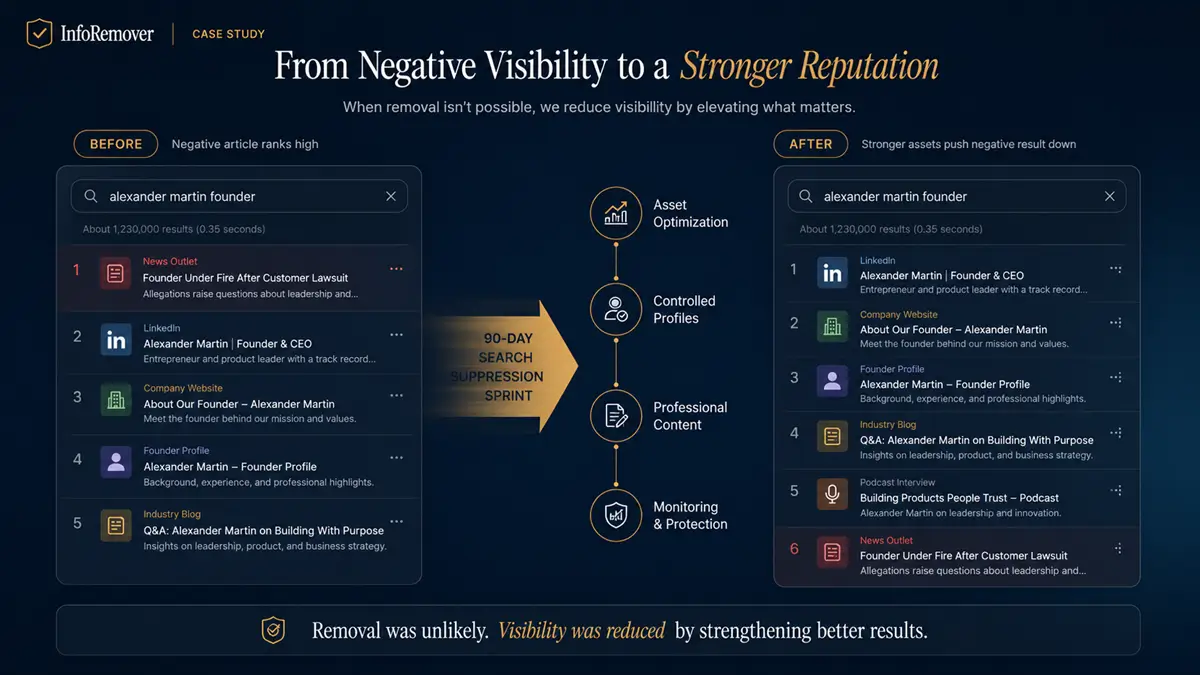
A founder-led professional services company contacted Info Remover after a negative article continued to appear on page one of Google for the founder's full name.
The founder was preparing for several important business conversations, including investor introductions, partner discussions and client renewals. During that period, they noticed that the article appeared prominently whenever someone searched their name.
The article was not new. It had been published several years earlier and related to a business dispute that had since been resolved. The search result still created a reputational issue because it appeared without context and was often one of the first things people saw.
Client profile at a glance
Client type: Founder and senior executive.
Issue: Negative article ranking on page one of Google.
Primary search query: Founder's full name.
Main concern: Due diligence risk before investor and partner conversations.
Initial goal: Remove or deindex the article if possible.
Final strategy: Search suppression after removal was determined to be unlikely.
The client's goal was clear. They wanted to know whether the article could be removed from Google. If removal was not realistic, they wanted a practical strategy to reduce the article's visibility and improve the overall search results for the founder's name.
The problem
The negative article appeared in the top five search results for the founder's full name.
The article was hosted on an established publication with strong domain authority. Although the underlying business issue had been resolved, the article remained live on the publisher's website and continued to rank because there were not enough stronger, current and relevant assets competing for the founder's name.
The client already had a LinkedIn profile and a company bio page, but both were under-optimized. There were also a few outdated directory profiles, an old podcast page, and several weak search results that did not clearly explain the founder's current role, experience or business activity.
This meant Google had a limited set of strong, current pages to show for the founder's name. The negative article filled that gap.
Baseline search result snapshot
At the start of the review, the first page of Google for the founder's full name looked roughly like this:
- LinkedIn profile
- Company homepage
- Negative article
- Old company directory listing
- Company team page
- Archived podcast page
- Generic business database profile
- Social media profile
- Old event listing
- Unrelated person with a similar name
The negative article was not the only result on page one, but it was one of the most visible and attention-grabbing. It had a strong title, an established publisher domain and enough relevance to the founder's name to remain competitive.
The client's existing positive assets were present, but they were not strong enough to consistently push the negative article lower.
Initial review: could the article be removed?
Before recommending suppression, Info Remover reviewed whether content removal or deindexing was realistic.
The review focused on five questions:
- Is the article still live on the publisher's website?
- Has the article been deleted, redirected or materially changed?
- Does the article expose sensitive personal information?
- Does the article appear to qualify for a search engine removal route?
- Is publisher outreach likely to result in removal, correction or noindexing?
The answer to the first question was important: the article was still live.
Because the source page remained available, a standard outdated content request was not appropriate. Outdated content removal is usually more relevant when a page has been deleted, significantly changed, or no longer contains the information shown in search. We covered this in detail in What to Do When an Old Page Still Appears in Google.
The article also did not primarily expose private personal information such as a home address, personal phone number, financial information or similar sensitive data. That made a personal information removal route unlikely.
Publisher outreach was considered, but the article was editorial content hosted on a publication that was unlikely to remove it without a strong reason. Info Remover also does not provide legal advice or legal claims, so any legal question would need to be handled by a qualified attorney.
After the review, the practical conclusion was simple: direct removal was unlikely to succeed quickly, and search suppression was the more realistic route.
Why suppression was recommended
Search suppression was recommended because the issue was not only the existence of the article. The larger issue was the weakness of the surrounding search results.
The founder did not have a strong enough search presence to compete with the negative article. The positive and neutral results that did exist were thin, outdated or poorly optimized.
Suppression gave the client a practical path forward by focusing on assets that could be improved or created.
The goal was not to delete the article. The goal was to make the first page of Google more balanced, current and representative of the founder's actual professional identity. This is also the underlying logic behind negative news suppression and executive due diligence cleanup.
Strategy
Info Remover built a 90-day suppression plan around one primary keyword: the founder's full name.
The strategy had four parts:
- Improve existing assets already ranking on page one or page two.
- Create stronger controlled assets that could rank for the founder's name.
- Publish neutral, professional content connected to the founder's expertise.
- Monitor movement and adjust based on ranking changes.
The client did not need a broad crisis campaign. They needed a focused name-based suppression sprint.
Month 1: audit, cleanup and asset optimization
The first month focused on improving what already existed.
Info Remover reviewed the client's existing search assets and identified which ones had the best chance of improving. Priority assets included:
- LinkedIn profile
- Company leadership bio
- Company about page
- Podcast appearance page
- Professional directory profile
- Business database profile
- Old event profile
- Personal domain that had not been used properly
Several of these assets mentioned the founder, but they were incomplete or inconsistent. Some used an old title. Others had thin bios, missing links or outdated descriptions.
The optimization work focused on:
- Consistent full name usage
- Updated job title
- Stronger professional biography
- Clearer company description
- Better internal linking
- Improved page titles where possible
- More complete profile information
- Updated professional photo where appropriate
- Linking between relevant assets
This work helped search engines better understand which pages were most relevant to the founder's name.
Month 2: controlled assets and supporting content
In the second month, the strategy shifted toward building new search assets.
The goal was not to create low-quality filler content. The goal was to create credible, useful and professional pages that could naturally rank for the founder's name.
New or improved assets included:
- A stronger founder biography page
- A personal profile page connected to the founder's work
- A professional author bio
- A short industry insight article
- A company leadership article
- Updated social and business profiles
The content was written to be factual and professional. It did not attack the negative article or try to directly explain it away. That would have drawn more attention to the issue.
Instead, the content focused on the founder's current role, expertise, business focus and professional background. This created more relevant search results that could compete for visibility.
Month 3: authority building and monitoring
By the third month, several assets had started to move.
The LinkedIn profile remained strong. The company leadership page improved. The updated founder bio page began appearing more consistently. A newly published professional article entered the lower part of the search results and later moved upward.
During this phase, Info Remover focused on:
- Strengthening internal links
- Updating content where needed
- Improving profile completeness
- Monitoring ranking movement
- Tracking the negative article's position
- Identifying which assets were gaining visibility
- Preparing next-step recommendations
Monitoring was important because search suppression is not linear. Some results move quickly, while others fluctuate. A result may move down one week and return the next. The goal was to observe the trend over time, not overreact to one ranking change.
Results after the suppression sprint
At the start of the project, the negative article appeared in the top five results for the founder's full name.
After the 90-day suppression sprint, the search results were more balanced. Several positive and neutral assets had strengthened, and the negative article was no longer as dominant as it had been at the beginning.
The final search result page included more current professional assets, including:
- LinkedIn profile
- Company leadership bio
- Founder profile
- Updated company page
- Professional directory profile
- Industry article
- Podcast and profile page
- Business profile
- Event profile
- Negative article lower than its starting position
The negative article was not removed from the internet. It was not deleted by the publisher. It was not guaranteed to stay in one position forever.
However, the client's search presence became stronger, more current and less dependent on a single negative result. The most important outcome was that the first impression for the founder's name improved.
What changed
Before the project, the founder's search results were thin. Google had only a few strong assets to choose from, which allowed the negative article to remain highly visible.
After the project, there were more relevant professional assets competing for the same search query. The improvement came from:
- Stronger existing profiles
- Better name consistency
- More complete professional pages
- New controlled content
- Better internal linking
- Current biography information
- Ongoing monitoring
Suppression worked because the search result page had room for improvement.
What did not happen
This case is also important because it shows what search suppression is not.
- The article was not deleted.
- The publisher did not remove the article.
- Google was not forced to remove the result.
- No legal claim was made by Info Remover.
- No ranking position was guaranteed.
Search suppression does not erase content. It works by improving the quality, relevance and strength of competing search results.
Why this case did not start with aggressive outreach
The client initially asked whether the publisher could be contacted.
Publisher outreach can be useful in some cases, especially when content is inaccurate, outdated, incomplete or easy to correct. In this case, aggressive outreach carried risks. It could have drawn renewed attention to the article. It could have triggered a refusal. It could also have wasted time if the publisher had no reason to remove or update the article.
Because the article was editorial, still live and hosted by a strong source, the more practical decision was to focus on assets the client could influence. That did not mean removal was impossible forever. It meant suppression was the better first operational strategy.
Key challenges
The article had authority. It was hosted on a strong website. That made it harder to outrank than a weak blog post, forum comment or directory page.
The client had limited controlled assets. Before the project, the founder had very few pages that clearly explained who they were and what they currently did.
The article matched the name query well. It mentioned the founder's full name directly, which made it relevant for the search query.
Search movement took time. Suppression required patience. New and updated assets needed time to be crawled, indexed and tested in search results.
Why the strategy worked
The strategy worked because it addressed the real weakness: the founder's overall search presence.
The negative article was strong, but the rest of the search results were underdeveloped. By improving the client's controlled assets and adding credible, relevant content, the search result page became less vulnerable to one old article dominating the narrative.
This is often the core logic behind suppression: if unwanted content cannot be removed, build stronger results around it.
What other clients can learn from this
This case shows why it is important to separate removal from suppression.
Content removal is best when a specific URL may be deleted, updated, deindexed or removed under a search engine or platform policy.
Search suppression is better when the content is still live, difficult to remove, hosted on a strong domain, or unlikely to qualify for a removal route.
For professionals, founders and executives, waiting until a negative result becomes a problem can make the situation harder. A stronger search presence built earlier can reduce the impact of unwanted content later.
When suppression may be the right option
Search suppression may be appropriate when:
- A negative article ranks for your name or brand
- The article is still live
- The publisher is unlikely to remove it
- Google removal routes do not apply
- The result appears on page one
- You have weak or outdated positive search assets
- You are preparing for due diligence, hiring, fundraising or media attention
- You need a more balanced search presence
Suppression is not a quick deletion tool. It is a structured visibility strategy.
How Info Remover helped
Info Remover helped by reviewing the search results, ruling out unrealistic removal routes, building a focused suppression strategy and tracking movement over time. The work included:
- Search result audit
- Negative article difficulty review
- Keyword mapping
- Existing asset optimization
- Founder profile strategy
- Professional content planning
- Controlled asset development
- Monthly ranking checks
- Written updates
- Final outcome report
The client received a clear record of what was reviewed, what was improved, what moved and what still required monitoring.
Final takeaway
This case started as a removal question.
The client wanted to know whether a negative article could be removed from Google. After review, the answer was that direct removal was unlikely because the article was still live, hosted by an established publisher and did not clearly fit a standard removal route.
Instead of relying on an unrealistic removal attempt, the client used search suppression. The result was a stronger, more current search presence and a less dominant negative article.
Removal is sometimes possible. When it is not, suppression can provide a practical alternative. For founders, executives and professionals, the lesson is simple: if one unwanted article is shaping the first impression, the solution may be to build a stronger search result page around it.
If you want a similar review of your own search results, you can start an intake and the team will tell you what looks realistic and what does not.